Not everyone can — or wants to — exercise. Maybe you have a knee injury, a packed schedule, a disability, or you simply hate the gym. Here is the good news: you can absolutely lose weight without exercise. Weight loss is driven mostly by what you eat, not by how much you sweat.
Research consistently shows that diet accounts for roughly 75–80% of weight loss, while exercise contributes the rest. That does not mean exercise is useless — it is excellent for your heart, mood, muscles, and long-term weight maintenance. But if exercise is off the table right now, your diet and daily habits can still carry you to your goal.
This guide walks you through 12 evidence-based strategies to lose weight without a single workout, plus the common pitfalls to avoid.
In This Guide You’ll Learn
- Why diet beats exercise for weight loss — the numbers behind it
- How to set a moderate calorie deficit without crash dieting
- How much protein you need when you are not exercising
- Simple portion, sleep, and stress strategies that control hunger
- A sample day of eating at around 1,600 calories
- When to see a doctor before you start losing weight
The Science: Why Diet Beats Exercise for Weight Loss
To lose one kilogram of body fat, you need a cumulative deficit of roughly 7,700 calories. Now consider this:
- A 60-minute brisk walk burns about 250–300 calories for an average adult.
- A single restaurant-style biryani plate can contain 900–1,200 calories.
That means one large meal can wipe out three hours of walking. It is far easier to not eat 500 calories than to burn 500 calories through exercise. This is why nutritionists say weight loss happens in the kitchen, not the gym.
Your body also burns calories just by existing — this is called your basal metabolic rate (BMR), and it accounts for 60–70% of your total daily energy expenditure. Add in the energy used for digestion and everyday movement (walking to the kitchen, fidgeting, standing), and most of your calorie burn happens without any formal exercise at all.
1. Create a Moderate Calorie Deficit (Not a Crash Diet)
Weight loss requires eating fewer calories than your body uses. But the key word is moderate. A deficit of 300–500 calories per day leads to steady, sustainable fat loss of about 0.25–0.5 kg per week.
Crash diets (eating under 1,200 calories a day) backfire badly. They slow your metabolism, trigger intense hunger hormones, cause muscle loss, and almost always lead to rebound weight gain. People who crash diet typically regain the weight — and often more — within a year or two.
How to do it right:
- Estimate your maintenance calories. A rough starting point: multiply your weight in kilograms by 25–28 if you are sedentary.
- Subtract 300–500 calories from that number.
- Track your food for 1–2 weeks using a free app or a notebook to learn your actual intake. Most people underestimate what they eat by 30–50%.
Here is what that looks like in practice:
| Your weight | Rough maintenance | Weight-loss target |
|---|---|---|
| 60 kg | 1,500–1,680 kcal | 1,200–1,380 kcal |
| 70 kg | 1,750–1,960 kcal | 1,450–1,660 kcal |
| 80 kg | 2,000–2,240 kcal | 1,700–1,940 kcal |
| 90 kg | 2,250–2,520 kcal | 1,950–2,220 kcal |
These are starting estimates, not prescriptions. Adjust based on your weekly weigh-ins: if you are not losing 0.25–0.5 kg per week after three consistent weeks, trim another 100–200 calories.
2. Prioritise Protein at Every Meal
Protein is the single most important nutrient when you are trying to lose weight without exercise. It keeps you full for longer than carbs or fat, costs more energy to digest, and protects your muscle while you are in a calorie deficit. Since you are not training, holding on to muscle matters even more — muscle keeps your resting metabolism higher.
Protein targets: Aim for 1.2–1.6 grams of protein per kilogram of body weight daily. For a 70 kg person, that works out to roughly 85–110 grams a day. Spread it across your meals rather than loading it all at dinner — about 25–35 grams per meal keeps hunger steadier through the day.
Practical protein sources (including South Asian options):
- Eggs (6 g per egg)
- Chicken breast (31 g per 100 g)
- Fish like rohu or surmai (20–25 g per 100 g)
- Lentils and daal (9 g per cooked cup, plus fibre)
- Chickpeas and kidney beans (15 g per cooked cup)
- Greek yoghurt / dahi (10 g per 100 g)
- Paneer (18 g per 100 g)
- Soya chunks (52 g per 100 g dry — the protein king of vegetarian options)
Start each meal by asking: “Where is my protein?” Build the rest of the plate around the answer. A breakfast of two eggs with vegetables, for example, will carry you to lunch far better than a plate of plain parathas.
3. Fill Half Your Plate With Vegetables

Vegetables are low in calories but high in volume, fibre, and water. They physically fill your stomach, which is one of the strongest fullness signals your body has.
A large bowl of mixed salad might contain 50–80 calories. The same volume of rice contains 400+. This principle — eating a larger volume of food for fewer calories, sometimes called volumetrics — is one of the most research-backed weight loss strategies that exists.
How to apply it:
- Start lunch and dinner with a vegetable soup or a large salad.
- Fill half your plate with cooked or raw vegetables before adding anything else.
- Keep cut vegetables (cucumber, carrots, bell peppers) visible in the fridge for snacking.
In South Asian cooking, this means generous portions of sabzi — bhindi, tori, karela, palak, gobhi — cooked with measured oil rather than floating in it.
4. Cut Liquid Calories Completely

This is the fastest, easiest win in weight loss. Sugary drinks — sodas, packaged juices, sweetened coffees, and sugary doodh patti — deliver a flood of calories without making you feel full. Your body barely registers them, so you eat just as much at your next meal.
Consider the damage:
- One can of soda: ~140 calories
- One glass of sweetened mango lassi: ~250–300 calories
- One large sweetened iced coffee: ~300–400 calories
- Two cups of sugary doodh patti daily: ~200 calories
That is potentially 500+ calories a day from drinks alone — enough to completely block weight loss. Many people find that cutting liquid calories is the single change that finally gets the scale moving.
Switch to: water, unsweetened green tea, black coffee, sparkling water with lemon, or plain lassi made with low-fat dahi and no added sugar. If plain water bores you, keep a jug in the fridge with cucumber, mint, or lemon slices.
5. Master Portion Control Without Counting Forever
You do not need to weigh food for the rest of your life, but learning correct portions for a few weeks recalibrates your eye. Most of us gradually drift toward bigger servings without noticing — and that drift alone can add hundreds of calories a day.
The hand method (no scale needed):
- Protein: one palm-sized portion
- Vegetables: two fist-sized portions
- Carbs (rice, roti, pasta): one cupped-hand portion
- Fats (oil, nuts, ghee): one thumb-sized portion
Practical tricks that work:
- Use smaller plates and bowls. People eat 20–30% less from smaller dishes without feeling deprived.
- Serve food in the kitchen, not at the table. Going back for seconds requires effort, which reduces mindless refills.
- Eat slowly and put your spoon down between bites. It takes about 20 minutes for fullness signals to reach your brain.
For roti lovers: two medium rotis instead of four, made with whole wheat and no ghee brushed on top, saves roughly 100–200 calories per meal without leaving you hungry.
6. Eat More Fibre
Fibre slows digestion, steadies blood sugar, feeds your gut bacteria, and keeps you feeling full for hours after a meal. It is one of the simplest dietary upgrades with the biggest payoff for weight loss.
Target: 25–30 grams of fibre per day. Most people get barely half that.
Best fibre sources:
- Lentils, chickpeas, kidney beans (7–8 g per cup)
- Oats (4 g per half cup dry)
- Vegetables and fruits with skin
- Whole wheat roti instead of white naan
- Chia seeds and flaxseeds (5 g per tablespoon)
A simple upgrade: swap white rice for brown rice or quinoa a few times a week, and choose whole fruit over juice. Increase fibre gradually and drink enough water, or you will feel bloated instead of satisfied.
7. Fix Your Sleep

This one surprises people. Poor sleep is directly linked to weight gain through two hunger hormones: ghrelin (which increases hunger) goes up, and leptin (which signals fullness) goes down when you are sleep-deprived.
In studies, people who sleep 5 hours a night eat 300+ more calories the next day than those who sleep 7–8 hours — mostly from snacks and sugary foods. Your tired brain craves quick energy, and your willpower is at its weakest.
Sleep rules for weight loss:
- Aim for 7–9 hours nightly.
- Keep a consistent sleep and wake time, even on weekends.
- Avoid screens 30–60 minutes before bed.
- Skip heavy, spicy meals right before sleeping.
If you are doing everything else right but sleeping 5 hours, fixing your sleep alone can restart stalled weight loss.
8. Manage Stress Without Food
Chronic stress raises cortisol, a hormone that increases appetite (especially for sugary, fatty comfort foods) and promotes fat storage around the belly. Many people eat in response to stress without realising it — the “I deserve this after a hard day” trap.
Stress eating is not a character flaw; it is a predictable hormonal response. The fix is to notice the pattern and redirect it.
Break the stress-eating cycle:
- Identify your triggers. Keep a simple note: what you ate, when, and how you felt. Patterns emerge within a week.
- Build a non-food stress toolkit: a 10-minute walk, deep breathing, calling a friend, a warm shower, or journaling.
- If you must snack when stressed, pre-portion it. Never eat from the packet.
Stress management is not soft advice — it is biochemistry. Lower cortisol means less belly fat storage and fewer cravings.
9. Eat Mindfully, Not in Front of Screens
Eating while watching TV or scrolling your phone is a weight-loss killer. Distracted eating makes you consume 25–50% more food because your brain does not properly register what you ate. You finish the meal feeling unsatisfied and reach for more.
Mindful eating basics:
- Sit at a table, not on the couch.
- Put the phone away during meals.
- Chew each bite thoroughly and notice flavours and textures.
- Stop at 80% full, not 100%. You can always eat more later if genuinely hungry.
This single habit change has helped many of our clients cut 200–300 daily calories without feeling deprived at all. It costs nothing and starts working at your very next meal.
10. Plan Your Meals (Even Loosely)

People do not fail diets because they lack willpower — they fail because they get hungry with no healthy food available. Then the nearest samosa shop wins.
You do not need rigid meal prep. Even a loose plan works:
- Decide dinner in the morning, not at 7 pm when you are starving.
- Keep 2–3 healthy default meals you can make in 15 minutes (daal + sabzi + roti; egg curry + salad; chicken soup).
- Stock your kitchen with the basics: lentils, eggs, frozen vegetables, oats, yoghurt, and spices.
When healthy food is the easy option, you will eat healthy food. Environment beats willpower every time.
11. Choose Smart Cooking Methods
How you cook matters as much as what you cook. Deep frying can triple the calories of a food. One tablespoon of oil adds 120 calories — and most home cooks pour far more than that without measuring.
Calorie-saving cooking swaps:
- Bake, grill, steam, or air-fry instead of deep frying.
- Use a non-stick pan so you need less oil.
- Measure oil with a spoon instead of pouring from the bottle.
- Make raita with low-fat dahi instead of full-fat.
- Choose tandoori or grilled kebabs over fried pakoras.
A plate of air-fried pakoras has roughly half the calories of deep-fried ones — same taste, far less oil. Small swaps like these quietly remove 200–300 calories a day without you eating any less food.
12. Be Patient and Track Progress Beyond the Scale
Weight loss without exercise is absolutely achievable, but it requires patience. A realistic rate is 0.25–0.5 kg per week through diet alone. Anyone promising faster results is usually selling water loss, not fat loss.
The scale does not tell the whole story. Water retention, hormones, and meal timing cause daily fluctuations that can hide real progress. Track several measures instead:
- Weekly average weight (weigh 3x a week, average it)
- Waist measurement monthly
- How your clothes fit
- Energy levels and sleep quality
If the scale stalls for 3+ weeks despite consistency, revisit your portions — “calorie creep” (gradually larger servings) is the usual culprit, not a broken metabolism.
A Sample Day of Eating to Lose Weight Without Exercise
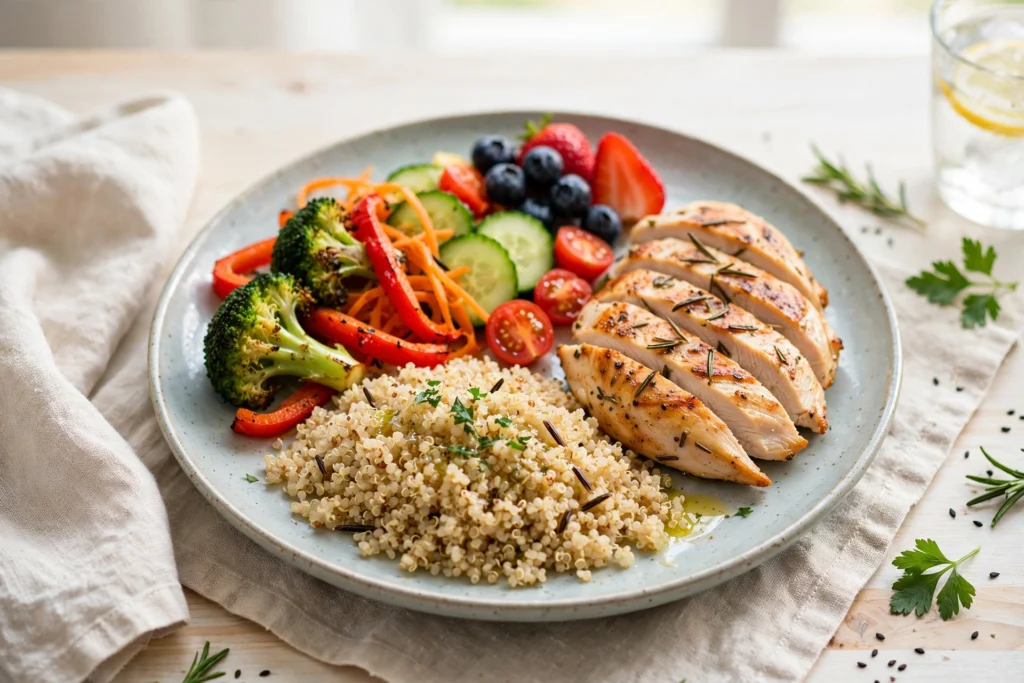
Theory is useful, but a concrete example makes it real. Here is a full day at around 1,600 calories that follows every principle above — high protein, half-plate vegetables, no liquid calories, and sensible portions. Adjust portions to your own calorie target from the table in tip 1.
- Breakfast (~350 kcal): Vegetable omelette made with 2 eggs, spinach, tomatoes, and mushrooms, plus one small whole-wheat roti.
- Mid-morning (~100 kcal): One medium apple or a small bowl of papaya with a squeeze of lemon.
- Lunch (~450 kcal): One cup of daal, one cup of mixed sabzi cooked in one teaspoon of oil, one medium roti, and a large cucumber-tomato salad.
- Evening (~150 kcal): A cup of low-fat dahi with a tablespoon of chia seeds, or a small handful (20 g) of roasted peanuts.
- Dinner (~450 kcal): Grilled chicken breast (120 g) or a cup of soya chunk curry, two cups of stir-fried vegetables, and half a cup of brown rice.
- Drinks all day: Water, unsweetened green tea, or black coffee. Nothing with calories.
Notice the pattern: protein at every meal, vegetables everywhere, and nothing to drink that costs calories. Eat like this consistently and the deficit takes care of itself.
Foods to Limit (Not Necessarily Eliminate)

You do not need to ban any food completely — that breeds rebellion and bingeing. But be honest about these high-calorie, low-satiety foods that quietly sabotage a deficit:
- Fried snacks (samosas, pakoras, namkeen)
- Sweets and mithai
- White bread, pastries, and bakery items
- Processed meats
- Full-fat dairy in large quantities
- Alcohol (7 calories per gram, zero nutrition, plus it lowers inhibitions around food)
The 80/20 rule works well: eat nourishing foods 80% of the time, enjoy treats 20% of the time without guilt. Guilt is not a weight-loss strategy; consistency is.
When to See a Doctor Before You Start
For most healthy adults, the strategies above are safe. But check with your doctor first if any of these apply to you:
- You have diabetes, thyroid disease, PCOS, kidney disease, or a heart condition.
- You take medication that affects weight, appetite, or blood sugar.
- You are pregnant, breastfeeding, or under 18.
- You have a history of disordered eating.
- You feel dizzy, extremely fatigued, or unwell on fewer calories.
Unexplained weight gain — or weight that will not budge despite a genuine, sustained deficit — can occasionally signal a hormonal or medical issue worth investigating. Please read our Health Disclaimer: this article is educational and is not a substitute for personalised medical advice.
Common Mistakes That Stall Weight Loss Without Exercise
Even with good intentions, these traps catch almost everyone at some point:
- Eating “healthy” but not less: Nuts, olive oil, and dry fruits are nutritious — but a handful of almonds is 160 calories. Healthy foods still count.
- Weekend blowouts: Five disciplined days undone by two days of unchecked eating. Aim for consistency, not perfection — but do not write off half the week.
- Drinking your calories back: The fresh juice, the “just one” cold drink, the sugary chai — liquid calories are the most common hidden saboteur.
- Skipping protein at breakfast: A carb-only breakfast spikes hunger by 11 am. Front-load your protein.
- Giving up after two weeks: Real fat loss is slow. Judge a plan after 4–6 consistent weeks, not 10 days.
Frequently Asked Questions
Can I really lose weight without any exercise at all?
Yes. Weight loss is fundamentally about consuming fewer calories than you burn, and diet controls the far larger share of that equation. Exercise helps health and maintenance, but it is not required to lose fat.
How fast can I lose weight without exercising?
A safe, sustainable rate is 0.25–0.5 kg per week through diet alone. Faster loss usually means muscle and water loss, not fat — and it rarely stays off.
Will I lose muscle if I do not exercise while dieting?
Some muscle loss is possible, but you can minimise it by eating enough protein (1.2–1.6 g per kg of body weight daily) and keeping your deficit moderate rather than extreme.
What is the best diet for weight loss without exercise?
There is no single “best” diet. The best diet is one you can stick to that creates a moderate calorie deficit with enough protein, fibre, and vegetables. Mediterranean-style and higher-protein patterns both work well for many people.
Why did I stop losing weight after the first few weeks?
Early rapid loss is mostly water. After 2–4 weeks, loss slows to the real fat-loss rate. True plateaus (3+ weeks with zero change despite consistency) usually mean portions have crept up — re-measure for a week.
Can I lose weight without exercise if I have thyroid or hormonal issues?
The same principles apply, but hormonal conditions like hypothyroidism or PCOS can make weight loss slower and may require medication to be properly managed first. Work with your doctor to get your condition treated, then apply these strategies — and be patient with a slower rate of loss.
Do I need supplements or fat burners to lose weight without exercise?
No. No supplement replaces a calorie deficit, and most “fat burners” are ineffective at best. The only supplements worth discussing with your doctor are ones that correct a genuine deficiency (such as vitamin D or iron), which a simple blood test can confirm.
The Bottom Line
Losing weight without exercise is not just possible — it is how most successful weight loss actually happens. Diet does the heavy lifting; the 12 strategies above give you the complete toolkit: a moderate deficit, plenty of protein and fibre, smart portions, better sleep, and honest tracking.
If you would like personalised guidance, our nutritionists can build a diet plan around your body, your routine, and the foods you actually enjoy. Book an online consultation and let us do the hard thinking for you.
Keep reading: our complete Weight Loss Nutrition Guide, a realistic diet plan for women’s weight loss, our 16:8 intermittent fasting starter guide, and how to speed up your metabolism after 40. For general healthy-eating principles, see the WHO healthy diet fact sheet.